
San Francisco Community
Ambassadors Program
As one of three Product Designers, I led the end-to-end interaction design and reporting workflow redesign for an internal mobile application used by San Francisco Community Ambassadors. By simplifying complex reporting workflows, the redesign reduced task completion time by 73% and increased operational efficiency across the program.


TEAM
3 Product Designers
TOOLS
Sketch, InVision, Google Forms
TIMELINE
4 Weeks
THEMES
Information Architecture, Interaction Design, Visual Design
INTRO
Field reporting slowed down the work that mattered.
San Francisco Community Ambassadors serve as the frontline connection between residents and city services, assisting with everything from helping tourists navigate the city to supporting vulnerable community members with essential resources.
Every interaction also had to be documented. Accurate reporting enabled team leads to monitor field activity, identify community trends, and demonstrate the program's impact to city leadership. However, the reporting process was time-consuming enough that it often interrupted the work it was intended to measure.
As a UX Designer, I redesigned the internal mobile reporting experience to help Ambassadors capture interactions more efficiently while improving reporting accuracy for the organization.
The redesigned experience enabled faster, more accurate reporting, supporting the documentation of over 142,000 interactions annually while helping the program serve more than 80,000 residents each year.

GOAL
How might we reduce the time and cognitive effort required for Ambassadors to document field interactions while improving reporting accuracy for program leadership?
Across 32 Ambassadors and 5 teams, documenting field interactions had become a slow and inconsistent process. My focus was to redesign the reporting workflow so Ambassadors could complete reports faster, reduce reporting errors, and spend more time engaging with the community rather than filling out forms.
32
Ambassadors
Feeling overwhelmed with long forms. Unaware of some mistakes in their responses
5
Team Leads
Receive inaccurate data due to some mistakes in Ambassadors’ input. Often spending time explaining how to log in some interactions to new Ambassadors every 3-6 months.
FIELD RESEARCH
To identify the frustrations in the existing system, we spent a week and a half observing and interviewing Ambassadors while working in the city. Field observations revealed an unexpected workflow. Ambassadors frequently interrupted active conversations to take handwritten notes before later re-entering the same information into Google Forms, creating duplicate work and increasing the likelihood of reporting errors.
Research Findings
Long reporting workflows increased completion time:
Reporting a single interaction required navigating up to ten separate form pages, making documentation slow and disruptive to field work.
Complex reporting led to inconsistent data:
New Ambassadors struggled to answer certain questions correctly, resulting in inconsistent reporting and additional coaching from team leads.
Success Goals
Streamline the reporting workflow:
Reduce unnecessary navigation through conditional branching and simplified reporting flows.
Reduce decision fatigue and reporting errors:
Show only contextually relevant questions using progressive disclosure, improving reporting accuracy while reducing cognitive load.
Accurate reporting was critical for leadership:
Leadership relied on accurate reporting to monitor field activity, identify community trends, and demonstrate the program's impact across San Francisco.
Create connected reporting workflows:
Unify incident reporting and event management into a single reporting experience, reducing context switching while improving workflow continuity.
Project Scope

THE SOLUTION
Redesigning the Reporting Workflow
We redesigned the reporting workflow around progressive disclosure, showing only the information required for each reporting scenario. This reduced unnecessary navigation, minimized cognitive load, and improved reporting efficiency without sacrificing data quality.


THE LAUNCH
Empowering Community Ambassadors with an efficient mobile system
The redesigned mobile experience reduced the friction of documenting field interactions by minimizing navigation, simplifying reporting workflows, and enabling Ambassadors to capture information immediately after each engagement.
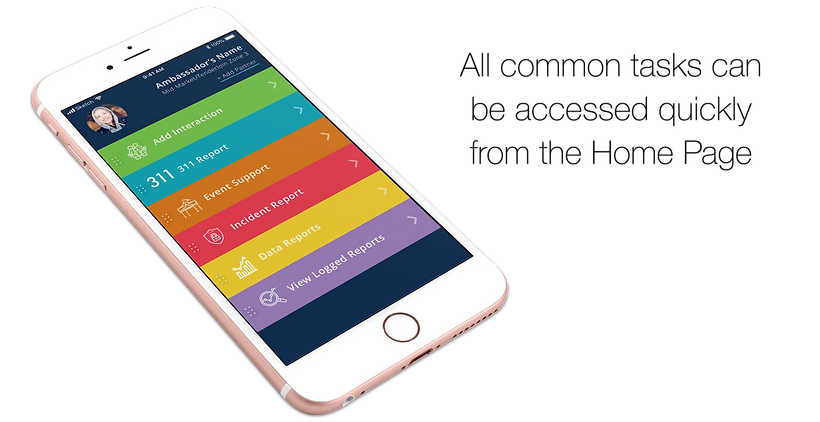
All common tasks can be accessed quickly from the Home Page


Log In / Sign Up
During field research, we observed that Ambassadors repeatedly entered static information, including team name and patrol zone for every report. We moved this information into onboarding, eliminating repetitive inputs across every future interaction.
Logging Actions
Actions are dynamically tailored to the selected interaction, surfacing only the fields required for that scenario. This reduces unnecessary decisions, improves reporting accuracy, and speeds up task completion.


Logging 311 Reports
311 reporting follows the same progressive disclosure approach, surfacing only the questions relevant to the selected issue while eliminating unnecessary steps.
Event Support
Events represented one of the most complex reporting workflows because Ambassadors coordinated multiple activities across locations, schedules, and teams. We designed a centralized event workspace that provided event details, instructions, participation, and reporting within a single workflow.


Logging Incident Reports
Incident reports currently exist as a separate Google form. We integrated Incident Reports into the primary reporting workflow, eliminating the need to switch between disconnected systems while preserving relationships between reports.
FUTURE VISION
A Wearable Device Version
One limitation remained, Ambassadors still needed to stop in a safe location before using their phones. A wearable experience could reduce this interruption by enabling lightweight, hands-free interaction directly from the field.


IMPACT
Results
73% Faster
Task Completion
Reduced documentation time while improving reporting consistency across the organization.
1.5X More
San Francisco Residents Helped
Measured by a 2-day work in a team of 3 Ambassadors in the Tenderloin area in San Francisco.
Improved Time Efficiency
I wanted to validate our proposed solutions by doing a side-by-side comparison of the time spent logging one of the most common tasks, a wellness check.
Current Google Forms
Improved Google Forms
The Mobile App
Success

“We had a great experience, and the work was super useful. Also, the teams loved being involved in the improvement of the program!”
— Community Ambassador Program Manager
NEXT ITERATIONS
Deepen our understanding.
-
Opportunity:
Each Ambassador team serves different communities with distinct reporting workflows and operational needs. -
Next Step:
Conduct usability testing across every Ambassador team to identify workflow differences and uncover opportunities for a more flexible reporting experience. -
Expected Impact:
Create a reporting experience that adapts to different team workflows without increasing complexity or sacrificing data consistency.
Feature: Event social groups.
-
Opportunity:
Large community events require Ambassadors to coordinate tasks and communicate efficiently while working across multiple locations. -
Next Step:
Expand Event Support with team collaboration features, allowing Ambassadors to share updates, coordinate responsibilities, and manage tasks from a single workspace. -
Expected Impact:
Reduce coordination overhead during events while improving team communication and operational efficiency.
Feedback on the design? Want to chat over coffee about building an app from scratch?
Feel free to get in touch or schedule a chat.